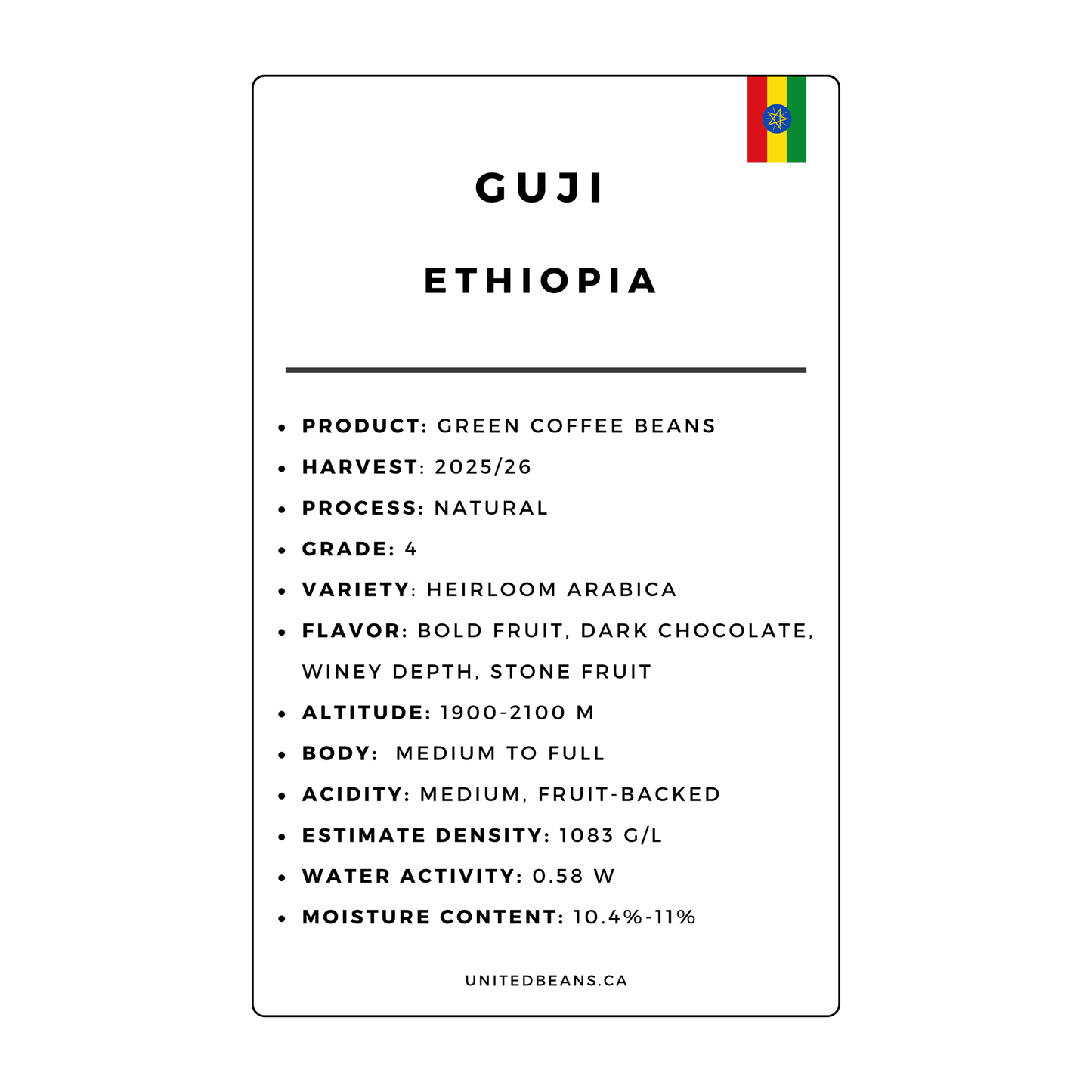


Ethiopia Guji Grade 4 is a naturally processed green coffee from the East Guji zone of Oromia, southern Ethiopia, grown at 1800-2100 metres above sea level. The 2025/26 crop lot is sourced through Primrose, the Ethiopian specialty coffee exporter whose Masina station in the Adola Woreda produced the coffee used by the 2018 World Barista Championship winner. Harvested from smallholder backyard garden farms in November and naturally processed on shade-covered raised beds, this lot delivers the bold fruit, chocolate, and winey depth that defines high-altitude Guji naturals. Density at 1,083 g/L and water activity at 0.518 confirm exceptional bean density and a well-dried, stable green coffee ready for immediate roasting or extended storage. 100% heirloom Arabica, available in 1 lb, 2.5 lb, 10 lb, 15 lb, and 30 lb.
Ships across Canada. Wholesale supply available.
Cup profile +
Aroma
Dark berry, dried fruit, cocoa, winey sweetness
Tasting notes
Bold fruit, dark chocolate, winey depth, stone fruit
Acidity
Fruit-backed, malic, rounded
Body
Dense, coating, fruit-rich texture
Finish
Long, sweet, winey with dark chocolate depth
Roasting guide +
At 1,083 g/L density this is a high-density natural green coffee that requires more heat energy and time to reach first crack than lower-altitude Ethiopian lots. Allow a thorough drying phase — natural process greens carry residual fruit sugars that need time to drive off evenly before Maillard begins. First crack tends to be well-defined at this density. Time from the first consistent cracking sounds.
Medium roast
Drop 45 seconds after first crack. Bold fruit and stone fruit most expressive. Chocolate develops cleanly. Winey character balanced. Excellent for filter and single origin espresso.
Medium-dark roast
Drop 75 seconds after first crack. Dark chocolate and dried fruit deepen. Winey depth becomes richer. Full body at its most expressive. Strong espresso blend base with distinctive Ethiopian character.
Dark roast
Drop 10 seconds after second crack. Bold, roasted, dark chocolate and smoky sweetness. Fruit recedes to background warmth. Heavy body. Suited to commercial espresso blends and French press programs.
About this coffee +
The Guji zone sits in the southern part of Oromia region, where the Oromo people have grown, harvested, and processed wild heirloom Arabica coffee for centuries. Growing at 2,100 metres above sea level — at the upper end of the Guji zone's altitude range of 1,950 to 2,300 metres — the farms contributing to this lot benefit from the slow cherry maturation that high altitude produces, concentrating sugars and aromatic compounds in the bean before harvest. Cherries are grown in smallholder backyard garden plots, harvested from November onwards, and delivered to collection stations where natural processing concentrates the fruit character further through sun-drying on shade-covered raised beds.
This lot is sourced through Primrose, the respected Ethiopian specialty coffee exporter led by Meseret Workneh. Primrose operates washing stations across the Guji zone and surrounding areas, including the Masina station whose coffee was used by the 2018 World Barista Championship winner — a recognition that reflects the exceptional quality ceiling of the Guji growing area and the standard of processing Primrose maintains across their station network. Grade 4 lots from the Guji area represent the accessible tier of that same origin quality, offering the distinctive Guji natural character at a price point suited to wholesale espresso blend programs and production roasting.
The technical specifications confirm a well-managed lot. Density at 1,083 g/L is high for a Grade 4 natural, reflecting careful cherry selection and thorough drying. Water activity at 0.518 is exceptionally low and stable — well below the 0.60 threshold at which microbial activity becomes a concern — confirming this green coffee is ready for immediate roasting or extended storage without quality degradation.
Specifications +
Origin
Ethiopia
Region
East Guji, Oromia
Producer
Primrose
Process
Natural (Sun-Dried)
Grade
Grade 4
Altitude
2,100 masl
Harvest
November onwards, 2025/26
Density
1,083 g/L
Water activity
0.518
Moisture
10.4% to 10.9%
Variety
Heirloom Arabica
Recommended roast
Medium, medium-dark, dark
Available sizes
1 lb, 2.5 lb, 10 lb, 15 lb, 30 lb
Frequently asked questions +
What is Guji and how does it differ from Yirgacheffe or Sidama?
Guji is a zone within the Oromia region of southern Ethiopia, recognised by the Ethiopian Coffee Exchange as its own distinct coffee-growing area since 2010. Prior to this, Guji coffees were often sold under the broader Sidamo designation. Guji sits at higher average altitudes than most Sidama production areas — typically 1,950 to 2,300 masl — and produces naturals with a bolder fruit character than Yirgacheffe, which is known for its floral delicacy. Where Yirgacheffe naturals lean toward jasmine and stone fruit, Guji naturals tend toward darker berry, winey depth, and cocoa — a fuller, more assertive profile that performs strongly in espresso and medium-dark filter programs.
What does water activity of 0.518 mean for this lot?
Water activity measures unbound water in the green coffee bean on a scale of 0 to 1. Specialty green coffee typically sits between 0.55 and 0.70. At 0.518 this Guji G4 is exceptionally well dried — below the range where any microbial activity can occur and well below the minimum threshold for quality concerns. Combined with moisture content of 10.4% to 10.9%, this confirms thorough drying management at the processing station and means the lot is stable for extended storage without quality degradation between purchases and roasting sessions.
Why is the density 1,083 g/L significant for a Grade 4 lot?
Density of 1,083 g/L is high for any Ethiopian natural, and particularly notable for a Grade 4 lot. Higher grades typically command higher density through more rigorous cherry selection. The fact that this G4 achieves 1,083 g/L density reflects both the extreme altitude at 2,100 masl — where slow cherry development concentrates nutrients into the bean — and the quality of processing at origin. For roasters, high density means more even heat absorption during roasting, better development consistency across the batch, and a cleaner, more complex cup than density numbers alone might suggest for a Grade 4 designation.
How should I store this green coffee?
Store in a cool, dry place away from direct light and moisture. Green coffee is stable for 12 to 18 months in correct storage conditions. We ship all our green coffee in 9 layer hermetic Ecotact bags to preserve moisture content and the aromatic character of this lot between roasting sessions.